

On 19th October 2025, a channel has been opened somewhere on Mastodon[1]like a fire kindled in the bottom of a field. There was no institution nor flag, only voices calling out to each other, people recognizing each other. This small group was named fedipourgaza. It is not an organization but a thread tightened between unknowns who refuse to look away. A handful of human beings who believe it is still possible to mend something in the world, pixel by pixel.
There is la petite dame brune, Arts teacher, who lends her voice to those who don’t have one anymore, Raphaella who passes messages on, Safae the poetess who slips words from Gaza on trains and café tables, Jeanne the writer. There is Gomli, country computer scientist, DIY flautist and artisan of code, Millerebonds the cyclist biologist who knows that code lines and plants roots breath the same way, Thom, who has a feet into technology, the other in solidarity. There are many more, quiet and steadfast.
At the core of the group, there is an idea born elsewhere, from Joy, Palestinian from Gaza, and Aral, Irish, on his island. On Mastodon, cries for help from Gaza came and went, like messages in bottles in a sea of indifference. Commercial medias banned these voices or buried them under algorithms. Thus another path was carved: Gaza Verified. Instead of blindly trust, Aral and Joy made the choice to humanly verify. A video talk on Signal or Jitsi, a face, a voice, a street in the background. On one hand, Joy as an interpreter, familiar with the dialect and the places, and Aral making a connection on the other hand. And when the truth came out, they added a little green check mark on the profile[2]. Nothing automatic, only the recognition of a living being.
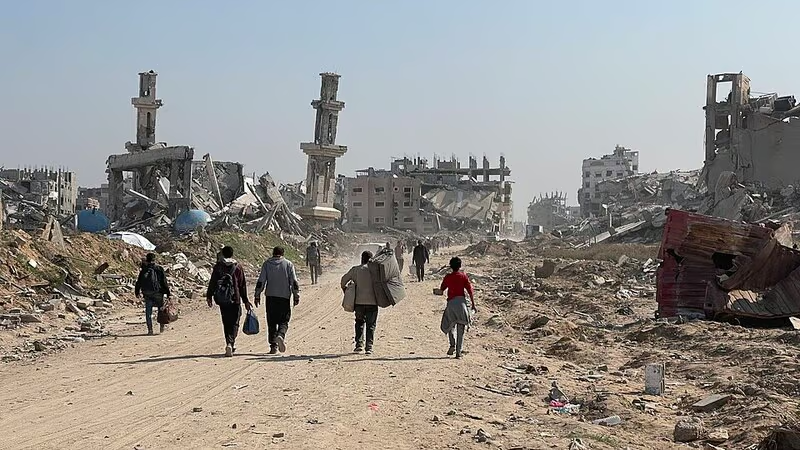
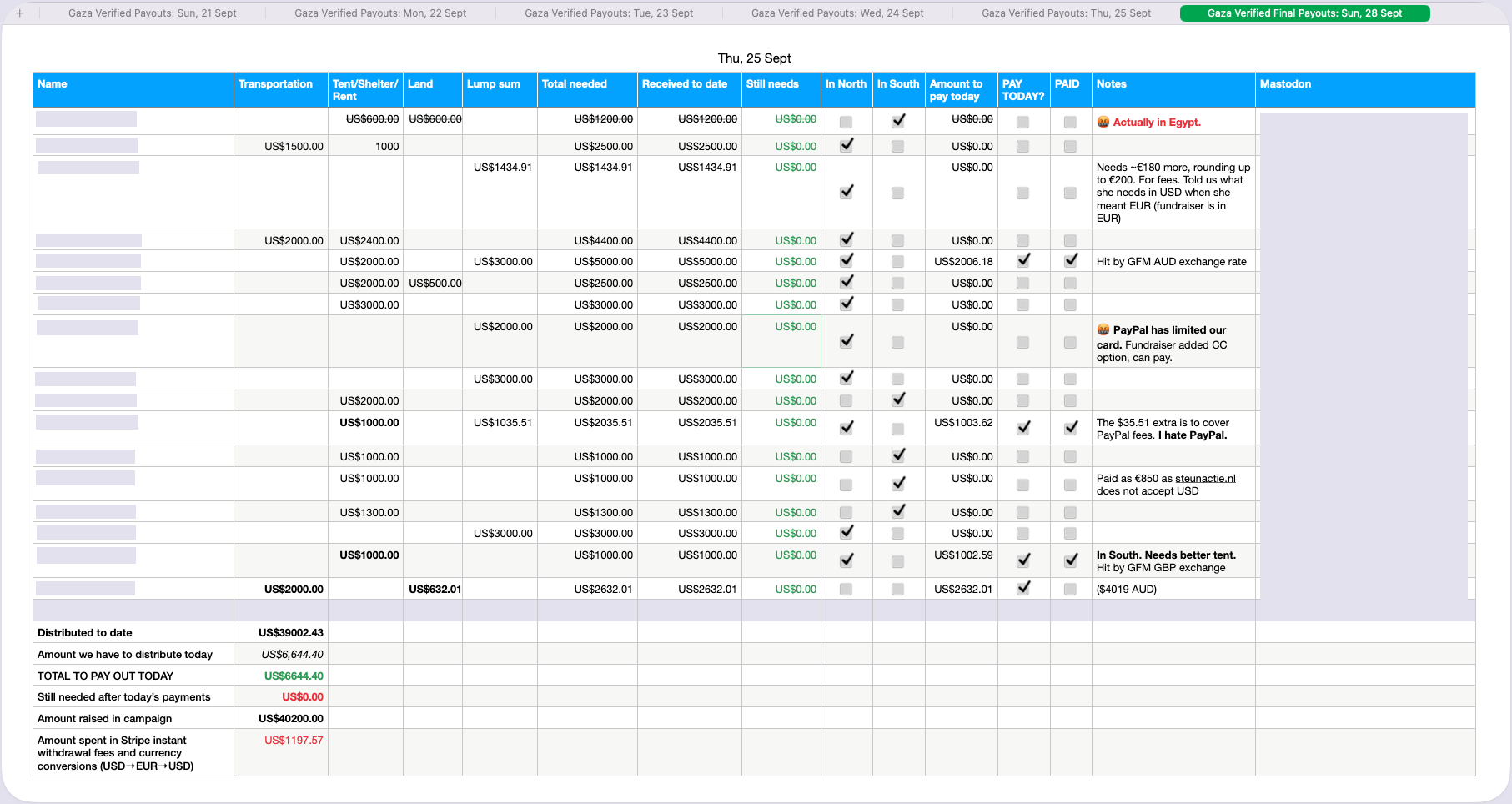
During the Israeli ground offensive, sixteen verified families were stranded in the North, without money to escape. Aral opened a fundraiser, hosted on his own free fondation, the Small Web Fondation. In a few days, forty thousand dollars[3] were raised, coming from all over the world. It was redistributed to the last penny for tents, trucks, lands, supplies. Aral made note of everything: conversions, fees, receipts, for the sake of accuracy – in a nearly painful way. Then he closed the fundraiser. He didn’t want, as he said, "to play god in deciding who gets help and who doesn’t"[4].
Each family kept their own funds. The network took over. That is when fedipourgaza rose. A bundle of screens and hands, a collective without centre that translates, relays, watches over. Each created on Mastodon a list of verified accounts, a protected garden where only authenticity grows. It’s a technical tool and yet fragile like a prayer: following without noise, translating without betraying, amplifying without misrepresenting. Messages from Gaza become faces. Aseel Monther young engineer writes: "I was walking down a street that had once been full of life […] Now, it was a graveyard of rubble and dust."[5] She describes children playing among rubble, their light laughters like pieces of glasses in the light. Mohammed Shobair confides: « My life depends on being able to use this app. […]My friends, if you ever see someone saying they wish me dead or rejoicing the war or asking questions in bad faith, please don’t engage. At all. You will not convince them. Go on with your day. At most, mute, or block. But don’t engage."[6] These words circulates from thread to thread, like a slow sap.
Members of fedipourgaza get organized. Millerebonds contacts independent web hosts, Thom writes portraits, Safae writes poems, la petite dame brune read poems to her students, Gomli gathers information, Jeanne writes this appeal. They translate, reformulate, give a personal touch: this text deeply moves me, this face haunts me, this sentence saves me. Posts become bridges. A poem, sometimes, brings light: « Il était une ville errante, béante, brûlante sous les feux des soldats. Gaza. » On the back, one word: #GazaVerified.
All is done without Big Tech. Mastodon to communicate, Signal and Jitsi to see each other, and free softwares to host it all. The global machine works without them, with the stubborn pace of those who refuse to remain silent.
Some days, reality walks through the screen. "The internet is expensive, I can’t afford to spend too much on it. Downloading videos and photos is expensive. […] I swear I’m trying my best."[7] Then: "Yesterday, my cousin Abdullah went to check on our house, but he and his friends were targeted on their way. His condition is critical, he needs surgery."[8] These sentences drop like pebbles in water. No one knows what to say. We share, we pass messages on, we go on.
Fedipourgaza has nothing of a miracle. It’s a patient weaving, a thread of trust among scattered people. While institutions hesitate, this small network of screens and hands hold on. Members don’t take themselves for heroes: they translate, share, tell, because it’s the only way to remain human.
In a world sick with suspicion, they chose trust as a way of resistance.
It’s not much. It’s huge.
Every donation becomes a breath, every words a helping hand.
And when the day rises in Gaza, and when the connection comes back for a minute, a sentence is enough to justify it all:
We are alive today.

Notes
-
[↑1] joinmastodon.org/fr
Mastodon is a free and open-source software platform for decentralized social networking with microblogging features, being part of the Fediverse (hence the name "FEDIpourgaza").
Each Mastodon instance has a physical server and the whole set operates as a decentralized and federated social network. -
[↑3] mastodon.ar.al/@aral/115284094354506634
"The appeal is now over.
In total, we raised $40,200. Of that we distributed $39002.43 to 17 different families. The rest went to Stripe and Wise (see below for details).
[...] I want to stress again not only how grateful I am but how much of a change you have made in the lives of the Gaza Verified families.
Multiple families have completed their evacuations South thanks to you. Others are closer to their goals or have land and shelter where they did not before." -
[↑4] mastodon.ar.al/@aral/115282136807492394
"we refuse to play god in deciding who gets help and who doesn’t" -
[↑6] mastodon.social/@mohshbair/115271524234436807
"My friends, if you ever see someone saying they wish me dead or rejoicing the war or asking questions in bad faith, please don’t engage. At all. You will not convince them. Go on with your day. At most, mute, or block. But don’t engage. Otherwise they get excited, and they get all over my mentions, then I feel terrible for hours. Life is hard enough. My life depends on being able to use this app, I can’t afford to feel anxious every time I open it. Don’t engage. Wishing you and everyone peace." -
[↑7] mas.to/@bilal_mo/115383825873716261
"I'm trying my best. I'm not someone used to sharing my life publicly, but I'm trying my best. I swear I'm trying my best, because I need help.
The internet is expensive, I can't afford to spend too much on it. Downloading videos and photos is expensive. Whenever we receive money, my family needs it for food.
I swear I'm trying my best." -
[↑8] mas.to/@bilal_mo/115396356679478201
"Yesterday, my cousin Abdullah went to check on our house, but he and his friends were targeted on their way.
His condition is critical, he needs surgery.
I didn’t want to mention it yesterday, I wanted us to spend one day with peace, without mentioning death. Friends, please help us before we lose him 😞"